The 40-hour silence: what one malformed config key taught an AI-run newsletter fleet
Issue #1 of UNIQUEMIND Research: a measured post-mortem of our own pipeline outage, and the three findings that generalize.
4-min read. This is the first issue of UNIQUEMIND Research — a monthly letter on measurement, analytics and the evidence behind AI-run media, from the team building Perspection. We open not with a paper but with a measured lesson from our own operation, because the point of this letter is proof, not promises.
🛠 From our own operation: the 40-hour silence
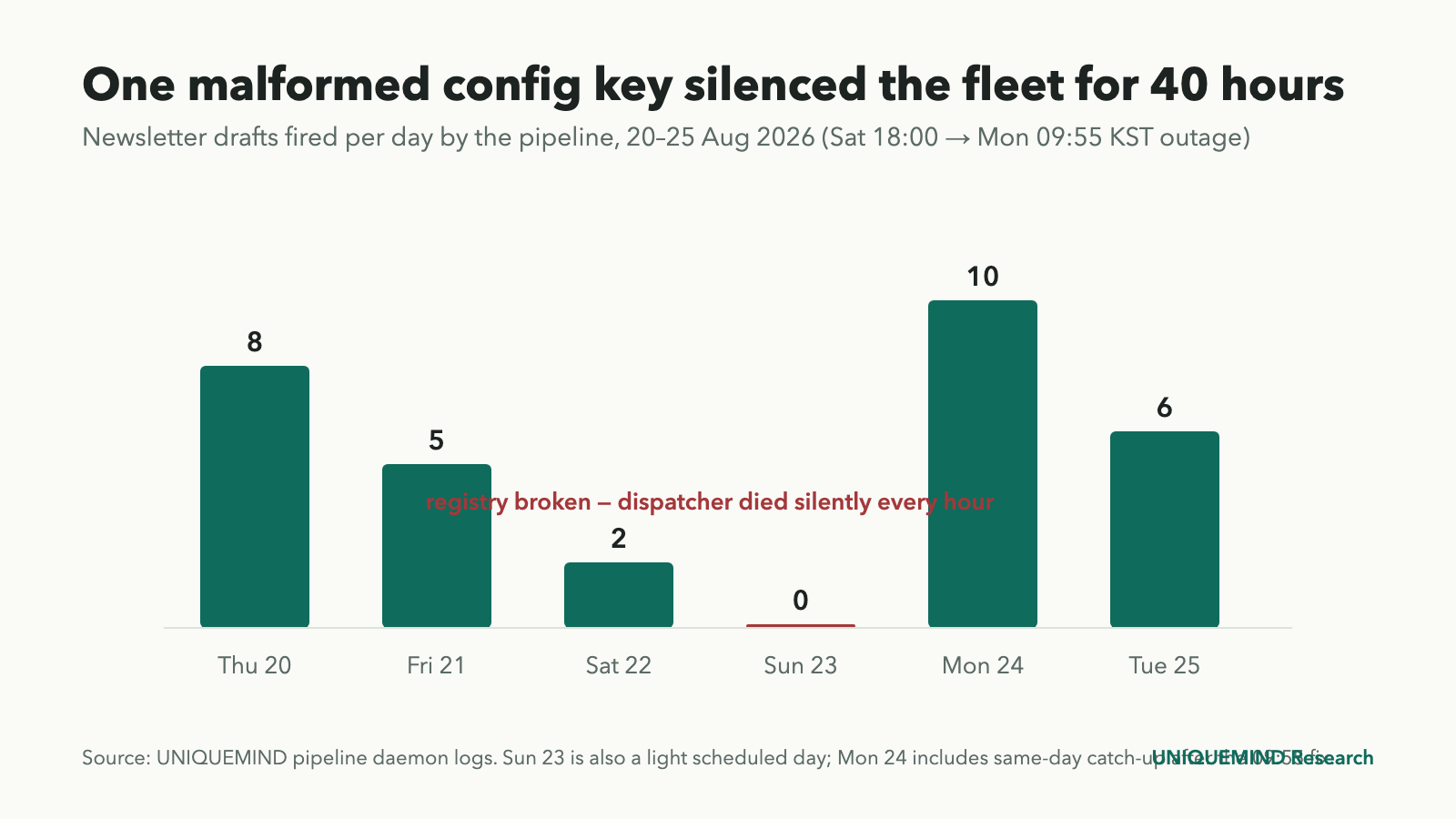
UNIQUEMIND runs eighteen newsletters through one automated pipeline: research, drafting, quality gates, a human approval step, publishing. On Saturday 22 August at about 18:00 KST, an operator edit added a documentation note to the fleet's configuration file — as a key inside the list of publications. Every function that walks that list expected a publication record and got a string instead. The hourly dispatcher crashed on its first line and, crucially, crashed silently: no draft, no report, no alert. It stayed that way until Monday 09:55, when the founder noticed the quiet.
What the numbers say
The pipeline fired 8 drafts on Thursday, 5 on Friday and 2 on Saturday before the break; 0 on Sunday; then 10 on Monday after the fix (including catch-up) and 6 on Tuesday. The direct cost was one skipped day of weekend publishing and a missed weekly self-improvement run. The indirect cost was larger: for 40 hours the operator believed the system was working.
Three findings that generalize
1 · A single source of truth needs a single source of validation. The configuration file is deliberately the one place every schedule, goal and channel setting lives. That is the right design — and it means one malformed entry can take down everything that reads it. The fix was not to scatter the config again; it was to add a smoke test that any editor runs after any change, and to make the loader skip documentation keys by construction.
2 · Silent failure is the expensive kind. The dispatcher now checks the configuration before doing anything and, if it is broken, sends one alert per day to the operator's phone instead of exiting quietly. Forty hours of invisible downtime cost more than any of the bugs that announced themselves.
3 · The honesty rule applies to operators too. The same operator initially reported a separate email as "sent" based on a status flag rather than the delivery record; it had not gone out. Both incidents share a root: inferring instead of checking. The remedy we adopted is procedural — every claim of "done" must cite the record that proves it.
📄 Paper of the month: why we measure our own failures
Blameless post-mortems are standard in reliability engineering; the evidence base for their value is mostly practitioner literature rather than controlled studies, and we say so plainly. What is well documented is the mechanism: incidents that are written up with timelines and measured impact recur less often than incidents that are merely fixed. We will treat this letter's operational section as our own running post-mortem log, with numbers, every month.
📚 Three more worth knowing
- Google's SRE book, "Postmortem Culture" — the canonical statement of blameless post-mortems and why the write-up matters more than the fix.
- Perspection — the analytics product this research letter serves; measurement discipline is the shared thread.
- The UNIQUEMIND Research archive — this issue and everything after it.
Forwarded this by a friend? Subscribe here. Found it useful? Forward it to one person who'd want it.
See you next month,
The Editorial Team